
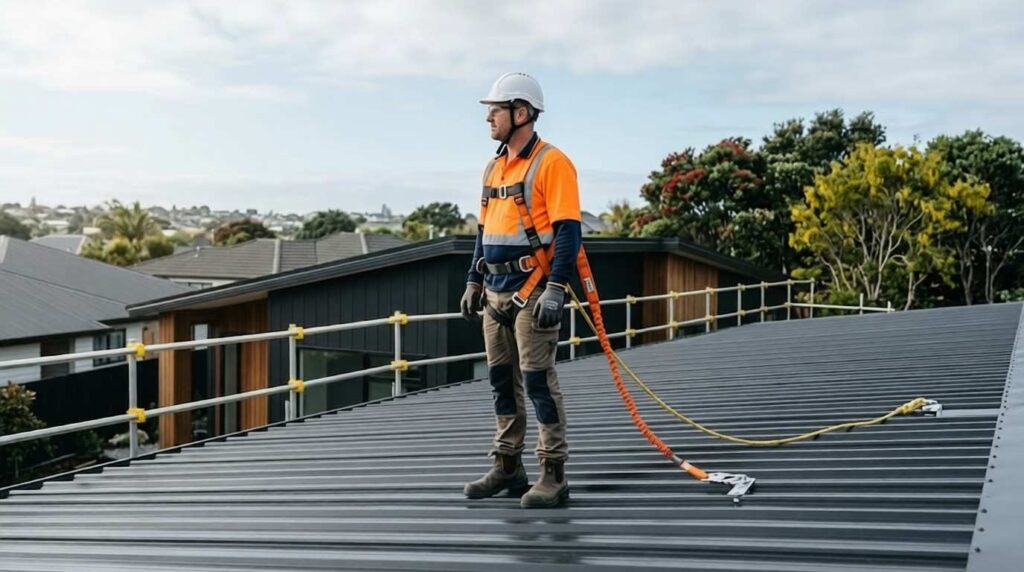
Roofing safety equipment is what stops a contractor from becoming a fall statistic on an Auckland roof. This guide breaks down the 7 categories that New Zealand’s Health and Safety at Work Act 2015 (HSWA) requires under WorkSafe NZ’s hierarchy of controls, what each piece does, and what to ask any Auckland roofing contractor before they step on your roof.
Roofing safety equipment is the harness, anchor, edge protection, helmet, footwear, roof bracket, ladder and high-vis system used to prevent falls and injury when working at height on a roof. In New Zealand, all work at height is regulated under the Health and Safety at Work Act 2015 (HSWA).
Most property owners do not think about safety gear until they have to. A contractor arrives, tools go up, and the assumption is that whoever is on the roof knows what they are doing. Sometimes that is true. Sometimes it is not, and the gap is where people get hurt.
Falls from height remain among the leading causes of serious injury and death across New Zealand worksites. WorkSafe NZ consistently places falls at the top of workplace fatality statistics, and residential roofing sits squarely in that risk category from the moment anyone steps above eave level.
Across Auckland, the mix of cyclone-prone wind exposure, Hauraki Gulf salt spray on coastal properties and volcanic-terrain steep pitches in suburbs like Mount Eden, Mount Albert and One Tree Hill puts extra stress on every safety system in use. Roof work on a North Shore beachfront property is a different job from roof work on a flat Central Auckland villa, and the safety equipment selection should reflect that.
This blog covers the roofing safety equipment that matters, what each piece does, and what property owners across residential, commercial and public buildings should expect when tradespeople are on their roofs. For full project work, see our re-roofing Auckland and new metal roofing service pages.
Roofing safety equipment is a system, not a single product. In New Zealand, work at height is regulated under HSWA 2015 and the General Risk and Workplace Management Regulations 2016. WorkSafe NZ working-at-height guidance sets out a hierarchy of controls: eliminate first, then passive protection, then collective controls, and personal protective equipment only when nothing else is reasonably practicable.
The hierarchy matters because it reveals which equipment is most effective. Edge protection beats a harness, not because harnesses do not work, but because edge protection does not depend on a worker remembering to clip in in the moment.
A safety harness for roofing is a full-body fall-arrest harness designed to distribute load across the thighs, chest and shoulders. NZ harnesses must meet AS/NZS 1891.1:2020. Manufacturer service life is typically 10 years from date of manufacture under AS/NZS 1891.4:2025 in-service guidance, and any harness involved in a fall arrest event must be retired immediately, regardless of visible damage.
Roof fall protection systems are the engineered anchors, lifelines and edge barriers that prevent or arrest a worker’s fall:
A hard hat is the worker’s primary defence against the falling-object hazard created by tools, metal offcuts and loose fixings on a roof. NZ hard hats must comply with AS/NZS 1801:2024 and be inspected for UV degradation, because the intensity of New Zealand sun breaks down polymer shells faster than most people realise.
Non-slip roofing footwear is purpose-built work boots with a sole compound rated for grip on metal surfaces. Dew, rain, lichen on older iron and even dust on a freshly installed sheet create slip conditions standard work boots cannot handle. Steel caps protect the toes, but the sole is what keeps the worker on the roof. Use boots tested for slip resistance under AS 2210.5:2019 (occupational protective footwear) and the ISO 13287:2019 test method.
Roof brackets and staging platforms are temporary level work surfaces fixed to the roof’s structural members. On pitched roofs they give workers a stable standing platform and transfer body weight to the purlin or batten rather than loading the sheet at mid-span. Critical on long corrugated iron runs where mid-span deflection causes loss of footing.
A ladder used for roof access is part of the safety equipment system, not just transport. NZ ladders must comply with AS 1892.1:2018 (metal and fibreglass portable ladders) and AS/NZS 1892.5:2000 (selection, safe use and care), be secured top and base, and extend at least one metre above the landing eave. A cracked stile, worn foot or missing rung is enough to take a ladder out of service.
High-visibility clothing and sun protection are the personal-protective layer for visibility and UV exposure on a roof. New Zealand has some of the highest UV radiation levels in the world due to ozone-layer thinning over the Southern Hemisphere, so long sleeves, broad-brim hard hats and SPF 50+ sunscreen are PPE here, not optional comfort. High-vis also keeps roof workers visible to ground crews and other trades around metal wall cladding on the building perimeter.
Roofing Safety Equipment at a Glance, NZ Standards and Requirements
Safety harness | AS/NZS 1891.1:2020 | Work above 2m with no passive controls |
Fixed/temporary anchors | Engineer-verified | Any harnessed work; permanent for repeat jobs |
Horizontal lifelines | AS/NZS 1891.2:2001 | Long metal roofing runs requiring movement |
Edge protection | AS/NZS 4994.1:2023 | Preferred passive control for roof perimeters |
Hard hat | AS/NZS 1801:2024 | All overhead work zones |
Non-slip footwear | AS 2210.5:2019 (slip resistance per ISO 13287:2019) | All metal roof surfaces |
Ladder | AS 1892.1:2018 + AS/NZS 1892.5:2000 | All roof access, secured + 1m above eave |
Knowing what roofing safety equipment looks like means you can ask better questions before anyone sets foot on your roof:
A competent contractor answers each directly. Evasive or vague responses tell you how the job is likely to be run.
Under the Health and Safety at Work Act 2015, a person conducting a business or undertaking (PCBU) carries a primary duty of care that can extend to contractors working on your property. Engaging a licensed, insured roofing contractor who takes roofing safety equipment seriously is the most straightforward way to meet that responsibility.
At HDK Long Run Roofing, safety equipment is part of every single job we take on, from residential re-roofs on the North Shore, West Auckland and Central Auckland villas to commercial installations across South Auckland and Hauraki Gulf coastal precincts. Our LBP-licensed team brings 10 years of Auckland metal roofing experience, backed by a 5-year workmanship guarantee and certified anchor systems on every site. Every worker is trained in the correct fit and use of a fall-arrest harness before they step on a roof, in line with NZ Metal Roofing Manufacturers industry practice and WorkSafe NZ guidance.
Safety is built into how we work, not bolted on afterwards. Book a free roof measure on 09 886 4625 and let’s do it properly from day one. For more on metal roofing safety, materials and maintenance, browse the HDK blog.
EXCELLENTTrustindex verifies that the original source of the review is Google. Absolute killer team! Contacted Jesse for a quote, he had organised a site assessment, drew up a quote and executed the job very quickly. I wouldn’t look anywhere else. These guys will help you all the way through! CheersPosted on GoogleTrustindex verifies that the original source of the review is Google. Garage side roof replacement. We reached out to several companies to inspect our roof and obtain quotes. It was challenging to get in touch with people since it was a mid-sized job and roofers are super busy. Jesse stood out as one of the best due to his prompt communication and very easy to deal with. Jesse and his team did an excellent job, delivering top-quality craftsmanship.Posted on GoogleTrustindex verifies that the original source of the review is Google. I had an outstanding experience with HDK Long Run Roofing. Their punctuality, clear communication, affordability, professionalism, speed, and friendliness were truly commendable. The end results exceeded our expectations, showcasing their dedication to quality work. I highly recommend their services.Posted on GoogleTrustindex verifies that the original source of the review is Google. Jesse and his team were great to deal with. They turned up on time, did the job expertly and efficiently, and invoiced as per the quote. Couldn’t have asked for anything more. Cheers HDK.Posted on GoogleTrustindex verifies that the original source of the review is Google. HDK replaced our entire roof and they did an absolute top job. Worked hard and committed to get it done in a timely manner and great guys to work with. Thanks all!Posted on GoogleTrustindex verifies that the original source of the review is Google. Full re-roof (iron) on my owner occupied 1920s home. Fantastic service from first contact right through to checking in following completion. The cheerful nature, quality of workmanship and professionalism made having Jesse’s team and their contracted scaffolders a pleasure to have on site. As a female home owner I’m always nervous about dealing with trades unless referred from friends and family, I could not recommend HDK highly enough and wish I’d engaged with them sooner. Love the sound of rain on the roof now I don’t have to worry about the leaks :)Posted on GoogleTrustindex verifies that the original source of the review is Google. What a cheerful respectful professional team. I have absolutely no hesitation in recommending this crew to others. Thanks Jesse and Trinity you made a potentially stressful job a breeze.Posted on GoogleTrustindex verifies that the original source of the review is Google. Replaced the roof with speed, efficiency, neatness and cheerful good humour. Jesse and his team are a pleasure to deal withPosted on GoogleTrustindex verifies that the original source of the review is Google. Amazing service and communication with this team. They really go above and beyond with their work and I would definitely recommend using them!
Roofing safety equipment in New Zealand is regulated under the Health and Safety at Work Act 2015 (HSWA) and the General Risk and Workplace Management Regulations 2016, enforced by WorkSafe NZ.
Yes, a safety harness for roofing is required when work is above 2 metres and the fall risk cannot be controlled by passive measures like edge protection or scaffolding.
Yes. Under HSWA 2015, a property owner who engages contractors can hold a duty of care alongside the contracting business as a person with control of a workplace.
Yes. Under HSWA 2015, a property owner who engages contractors can hold a duty of care alongside the contracting business as a person with control of a workplace.
Auckland Council inspections expect contractors to follow WorkSafe NZ’s hierarchy of controls and AS/NZS standards, with the Safe Work Method Statement available on request.